

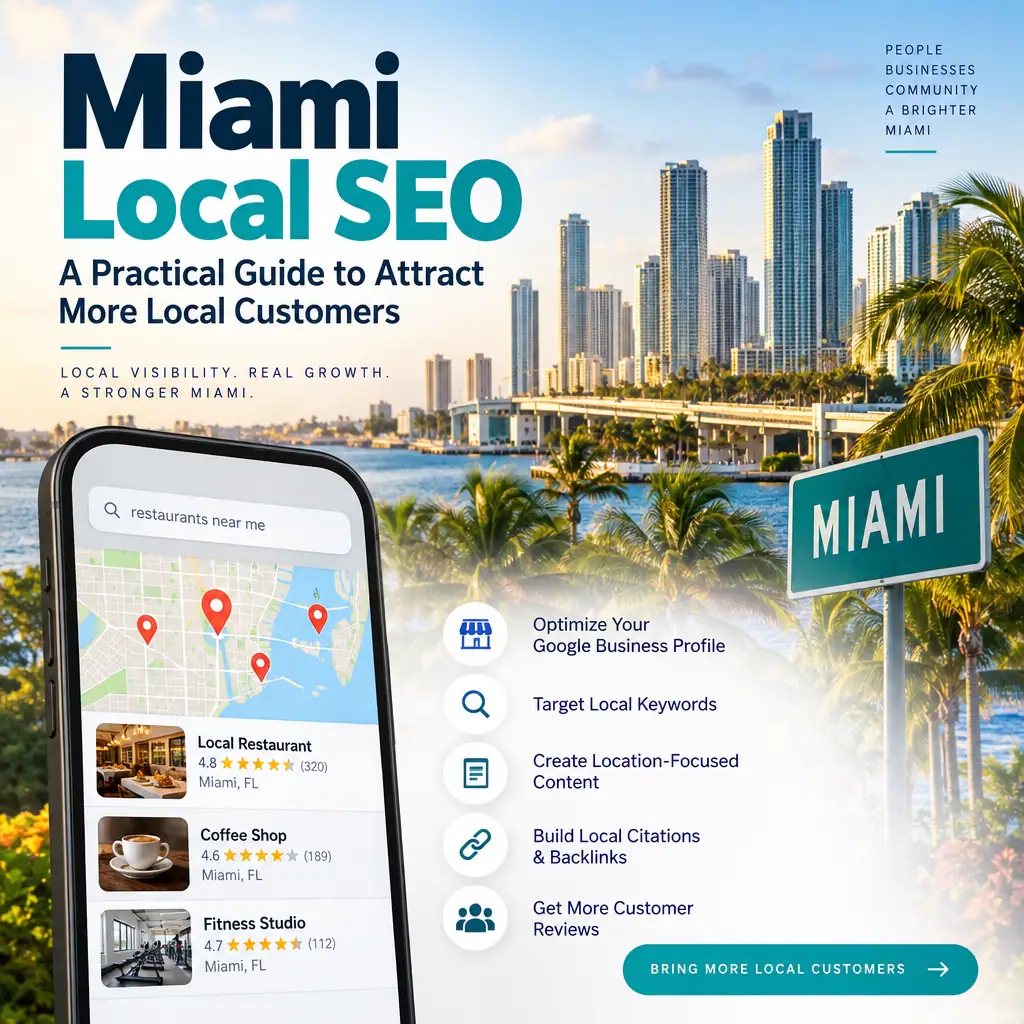
Miami Local SEO: A Practical Guide to Attracting More Local Customers
Miami Local SEO: A Practical Guide to Attracting More Local Customers
Miami is a competitive market where neighborhood identity, cultural diversity, and convenience influence buying decisions. A restaurant in Little Havana, a dental office in Brickell, and an air conditioning company serving Kendall all need visibility, but they do not need the same search strategy.
Local SEO helps Miami businesses connect with people searching for nearby products and services. Rather than attracting traffic from everywhere, it focuses on reaching customers within the areas a business can realistically serve.
For local businesses in Miami, success requires more than adding a city name to a website. It depends on accurate business information, useful location-specific content, a strong Google Business Profile, and a reputation that inspires trust.
What Is Local SEO?
Local search engine optimization is the process of improving a business’s visibility in geographically relevant search results. These results may appear in Google Maps, the local map pack, and standard organic listings.
Local searches often include phrases such as:
- Emergency plumber in Miami
- Brickell dentist
- Cuban restaurant in Little Havana
- AC repair in Kendall
- Accounting services near Coral Gables
Search engines can also recognize local intent without an explicit location. Someone searching for a nearby coffee shop on a phone may receive results based partly on their current location.
Google describes its local ranking system in terms of three primary factors:
Relevance: How closely a business matches the search.
Distance: How far the business is from the location associated with the search.
Prominence: How well known the business is, informed by signals such as reviews and links.
A business cannot optimize away physical distance, but it can improve how accurately it communicates its services and how credibly it presents itself online.
Why Miami Businesses Need a Local Search Strategy
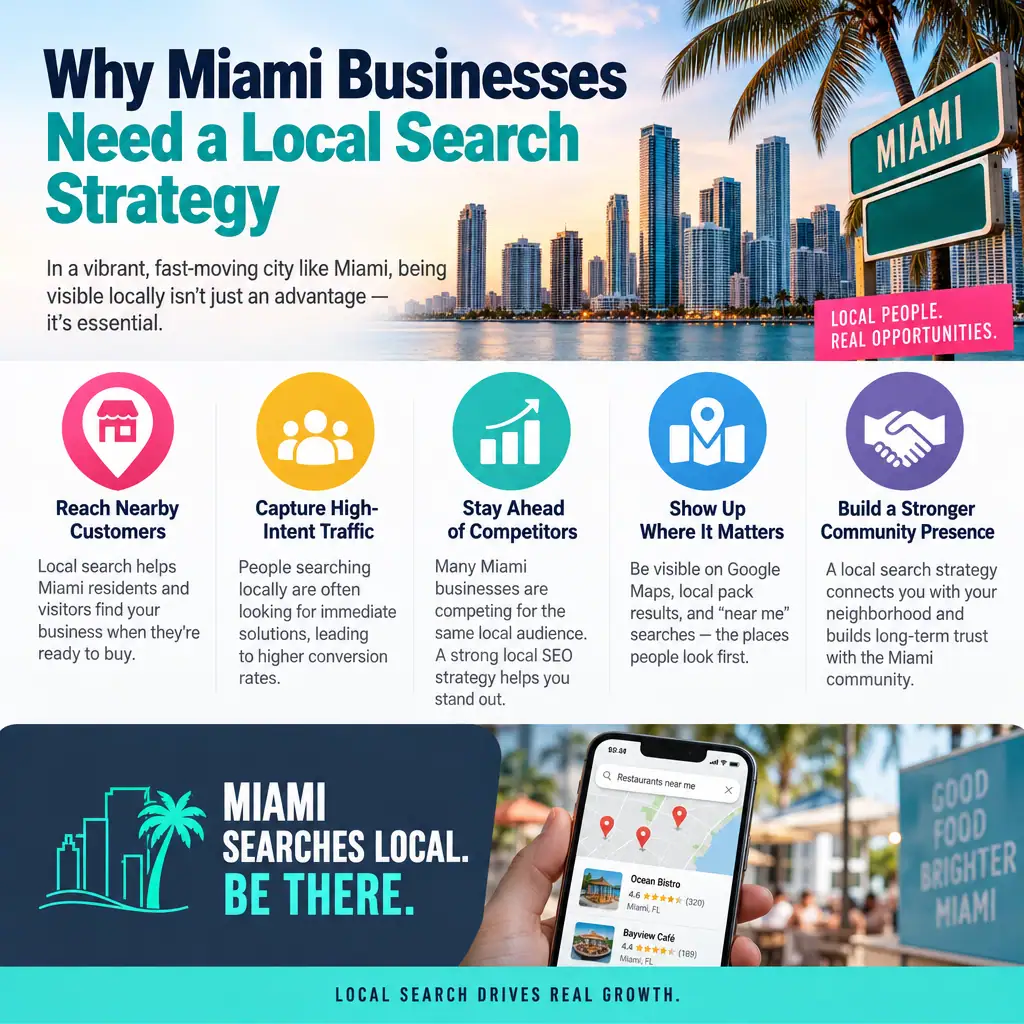
Miami is not one uniform market. Customers in Downtown Miami may have different priorities from those in Coconut Grove, Doral, or North Miami. Some seek walkable options, while others need mobile service providers, convenient parking, or weekend appointments.
The market also includes year-round residents, visitors, seasonal residents, and international customers. Each group may search differently.
A useful Miami local SEO strategy accounts for:
- The neighborhoods and municipalities a business actually serves
- The services most valuable to nearby customers
- The languages the business can genuinely support
- Location-specific concerns, such as access and parking
- Seasonal changes in demand
The objective is not to appear for every Miami-related search. It is to become a relevant option for searches most likely to produce qualified inquiries, appointments, and purchases.
1. Build a Complete Google Business Profile
For many customers, a Google Business Profile is the first interaction with a local business. They may call, request directions, view photos, or compare reviews before visiting the website.
Start by claiming and verifying an eligible profile. Then keep its details accurate.
Select Appropriate Categories
Choose the most specific available primary category that describes the main business. Add secondary categories only when they reflect services the business genuinely provides.
Categories should describe the business, not serve as a list of target keywords.
Keep Core Information Accurate
Review the following details regularly:
- Business name
- Address or service area
- Phone number
- Website
- Regular and special hours
- Appointment links
- Available services
Use the real-world business name. Adding extra service keywords or neighborhood names that are not part of the business name can violate Google’s guidelines.
Represent Your Location Honestly
Businesses that travel to customers and do not receive them at their address should follow Google’s service-area business requirements, including hiding the address where appropriate.
Do not create profiles for virtual offices or locations that do not meet eligibility requirements. Adding service areas also does not guarantee rankings throughout those areas.
Add Useful Photos and Updates
Show customers what to expect through original images of the storefront, team, facilities, products, or completed work.
Updates about services, events, and changing hours help keep information useful. Treat these features as customer communication tools rather than guaranteed ranking boosts.
2. Research How Miami Customers Search
Effective keyword research connects services, locations, and customer intent.
A Miami roofing company might investigate searches related to roof repairs, inspections, leaks, and replacement. A law firm would need a different set of terms tied to its practice areas.
Organize research into three categories:
Service Searches
These identify the core offering:
- Miami commercial cleaning
- Miami family dentist
- Miami appliance repair
Neighborhood Searches
These reveal demand within specific areas:
- Coconut Grove personal trainer
- Wynwood hair salon
- Coral Gables estate planning attorney
Urgent or Decision-Focused Searches
These often indicate an immediate need:
- Same-day AC repair Miami
- Emergency electrician Miami
- Miami dentist open Saturday
Only target claims the business can fulfill. A page promising round-the-clock service is misleading if no one is available overnight.
Use search data, customer questions, and existing inquiries to prioritize topics. Keyword volume alone does not reveal whether a searcher is a good fit for the business.
3. Create Service Pages That Answer Real Questions
A single general services page often lacks the detail customers need to make a decision.
Give major services dedicated pages when there is enough distinct information to justify them. Each page should explain:
- What the service includes
- Who it is intended for
- Where it is available
- How the process works
- What may affect pricing
- Why customers should trust the provider
- How to take the next step
For a Miami AC repair business, useful content could explain diagnostic visits, common symptoms, scheduling, and repair options. Local context might include the demands of hot, humid weather, but the page should remain focused on helping the customer.
Include relevant keywords naturally in titles, headings, and body content. Repeating Miami local SEO-style location phrases mechanically makes pages harder to read and adds little value.
4. Develop Location Pages With Genuine Local Value
Location pages can help businesses explain their availability across Miami and nearby communities. However, copying one page repeatedly and changing only the neighborhood name produces weak content.
A strong location page may include:
- Services available in that area
- Actual project examples
- Relevant customer testimonials
- Travel or scheduling details
- Neighborhood-specific questions
- Directions to a legitimate office
- Original photos connected to local work
For example, a contractor serving condo owners in Brickell might discuss building access and association coordination. A landscaping company serving suburban properties could address a different set of practical needs.
Create pages only where there is meaningful information to share. Never imply that a staffed office exists in a neighborhood when it does not.
5. Consider English and Spanish Content Strategically
Miami’s multilingual population creates opportunities for businesses that can serve customers in more than one language.
If Spanish-speaking staff and service support are available, Spanish-language pages can make the business more accessible. These pages should be written or reviewed by a fluent professional and adapted to how customers actually search.
A sound multilingual approach includes:
- Separate, accessible URLs for each language
- Clear language navigation
- Accurate translations of services and policies
- Consistent contact information
- Appropriate hreflang implementation
- Inquiry handling in the advertised language
Do not publish Spanish-language sales pages if customers cannot receive the promised support. Language accessibility should continue beyond the website.
6. Earn Reviews Through Consistent Customer Service
Reviews help potential customers evaluate a business and can contribute to local visibility.
Build a repeatable process for requesting honest feedback after completed appointments, purchases, or projects. A direct review link can reduce friction.
Follow platform policies and avoid:
- Buying reviews
- Offering incentives for Google reviews
- Requesting reviews only from satisfied customers
- Writing reviews on a customer’s behalf
- Asking employees or other conflicted parties to pose as customers
Respond professionally to both positive and negative feedback. Thank customers, address concerns without revealing private information, and move sensitive discussions to an appropriate private channel.
A credible reputation grows from real experiences, not a sudden burst of manufactured praise.
7. Maintain Consistent Business Listings
Customers may discover a business through maps, industry directories, social platforms, and local organizations.
Keep the business name, address, and phone number accurate across important sources. This is especially valuable after a move, rebrand, or phone-number change.
Prioritize:
- Major mapping platforms
- Relevant industry directories
- Established local business organizations
- Frequently used customer review platforms
- Active social media profiles
Consistency reduces confusion, but minor formatting differences are usually less important than incorrect or outdated information.
Avoid paying for hundreds of low-quality directory submissions. A smaller set of accurate, relevant listings is generally more useful.
8. Build Local Authority Through Real Relationships
Relevant links and mentions can strengthen a website’s authority while introducing the business to local audiences.
Miami businesses can pursue opportunities through:
- Community organizations
- Professional associations
- Local events
- Charitable partnerships
- Neighborhood publications
- Supplier and business partnerships
The strongest opportunities begin with genuine involvement. A business might contribute expertise to a local publication, host an educational workshop, or participate in a community initiative.
Do not treat sponsorships as a way to buy ranking credit. Paid links should be handled according to search engine guidelines, and partnerships should offer value beyond SEO.
9. Make the Website Fast, Clear, and Mobile-Friendly
Local customers often search while traveling, comparing providers, or dealing with an urgent problem. A confusing website can lose a lead even when search visibility is strong.
Prioritize:
- Readable mobile layouts
- Fast-loading pages
- Tap-to-call phone numbers
- Simple inquiry forms
- Clear service information
- Accessible navigation
- Secure connections
- Working appointment links
Display essential details where users can find them easily. A restaurant may need prominent menus and hours, while a service company may benefit most from clear availability and a short estimate request form.
Structured data can help search engines understand eligible business information. Use an appropriate LocalBusiness type and ensure the markup matches visible content. Structured data does not guarantee higher rankings or enhanced search appearances.
10. Publish Content Around Local Customer Needs
Useful content answers questions people ask before choosing a provider.
Potential Miami-focused topics include:
- What condo owners should know before scheduling renovation work
- How to prepare an air conditioning system for heavy summer use
- Questions to ask when choosing a wedding venue in Miami
- What first-time clients should bring to a professional consultation
- How to reach a business using nearby parking or transit options
Keep topics connected to the business’s expertise. A generic Miami travel guide is unlikely to help an accounting firm attract qualified clients.
Original examples, clear explanations, and accurate local details provide more value than long articles built around repeated keywords.
11. Measure Leads and Revenue, Not Just Rankings
Rankings vary by searcher location, query, device, and other factors. One ranking check cannot represent visibility across the entire Miami area.
Track a combination of indicators:
| Metric | What It Helps Reveal |
|---|---|
| Local organic traffic | Whether relevant visitors are reaching the website |
| Business Profile interactions | How people engage with the listing |
| Calls and form submissions | Whether visibility generates inquiries |
| Appointment bookings | Whether inquiries become scheduled business |
| Qualified leads | Whether the strategy attracts suitable customers |
| Revenue from local search | Whether the effort supports business growth |
Google Search Console, website analytics, and Business Profile performance data offer complementary insights.
Review which services and locations generate meaningful results. A modest increase in qualified leads can matter more than a large increase in unrelated traffic.
A Practical 90-Day Starting Plan
Days 1–30: Establish Accuracy
Audit the Google Business Profile, website, and major listings. Fix inaccurate contact details, review profile eligibility, and establish baseline performance measurements.
Days 31–60: Improve Core Pages
Strengthen priority service pages, address mobile usability problems, and develop genuinely useful location content where needed. Begin a consistent, policy-compliant review request process.
Days 61–90: Expand and Refine
Publish content based on customer questions, pursue relevant local relationships, and evaluate inquiry quality. Use the findings to adjust priorities.
This timeline provides a working structure, not a promise of results. Progress depends on competition, proximity, website condition, and the business’s existing reputation.
Build Local Visibility That Supports Long-Term Growth
Miami local SEO works best when it reflects the business accurately and makes choosing it easier.
A complete Google Business Profile, helpful service pages, authentic reviews, and a reliable website create a strong foundation. Neighborhood knowledge, appropriate multilingual support, and real community relationships can make that foundation more competitive.
For Miami local businesses, the goal is not simply more search exposure. It is becoming a trusted, accessible choice when nearby customers are ready to act.